TECHNOLOGY
Metal–Organic Framework (MOF)
Engineering Water from the Atmosphere
Water exists all around us—even in the driest regions on Earth.
Every cubic meter of air contains water molecules suspended as invisible vapor.
The challenge has never been the availability of water in the atmosphere; it has been developing a material capable of harvesting it efficiently with minimal energy.Metal–Organic Frameworks (MOFs) represent one of the most significant advances in materials science over the past two decades.
Their unprecedented surface area, precisely engineered pore architecture, and molecular selectivity allow them to capture water vapor directly from ambient air with extraordinary efficiency.This breakthrough is redefining how humanity can access fresh water in a changing climate.
What is a Metal–Organic Framework?
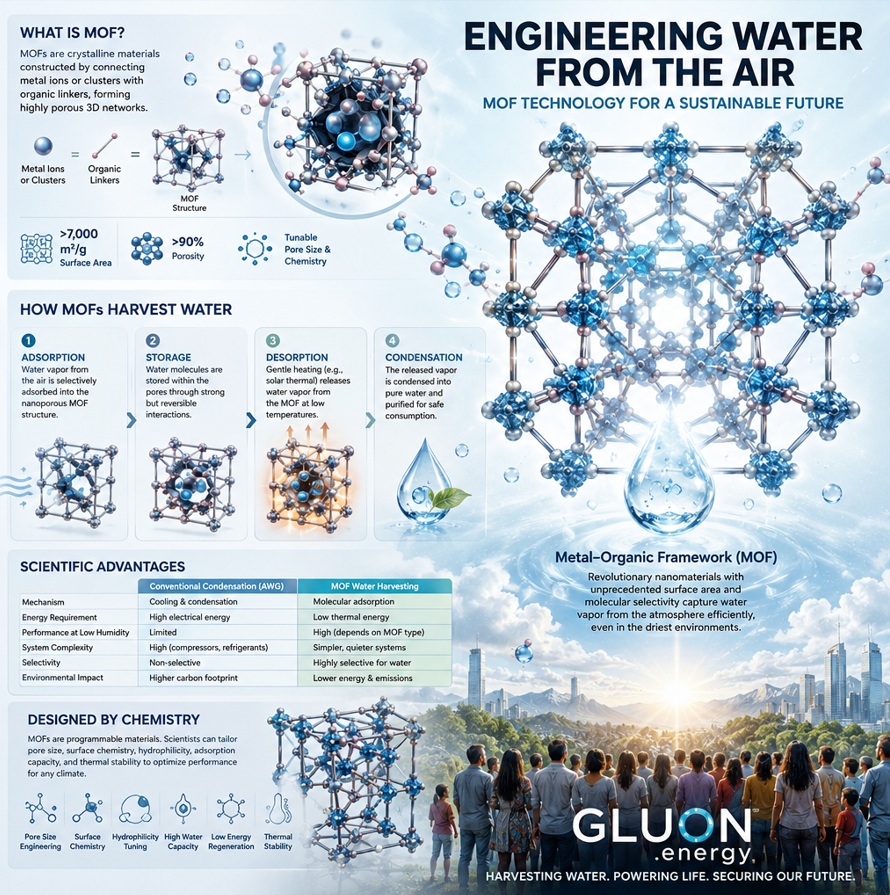
A Metal–Organic Framework is a highly ordered crystalline material constructed by connecting: Metal ions or metal clusters Organic molecular linkersinto a three-dimensional porous network.
Unlike conventional porous materials, every pore within a MOF is engineered at the molecular level, allowing scientists to precisely control how specific molecules interact with its internal surface.
A single gram of advanced MOF material may possess an internal surface area exceeding 7,000 square meters—equivalent to nearly an entire football field contained within the volume of a teaspoon.
This enormous internal surface creates billions of nanoscale adsorption sites capable of selectively attracting water molecules from surrounding air.
Why MOFs Are Transformational
Traditional atmospheric water generators consume significant electrical energy because they must cool large volumes of air until moisture condenses.
MOFs fundamentally change this paradigm.
Instead of cooling the atmosphere, they selectively harvest only the water molecules.
This dramatically reduces unnecessary energy consumption while extending operation into climates previously considered unsuitable for atmospheric water harvesting.
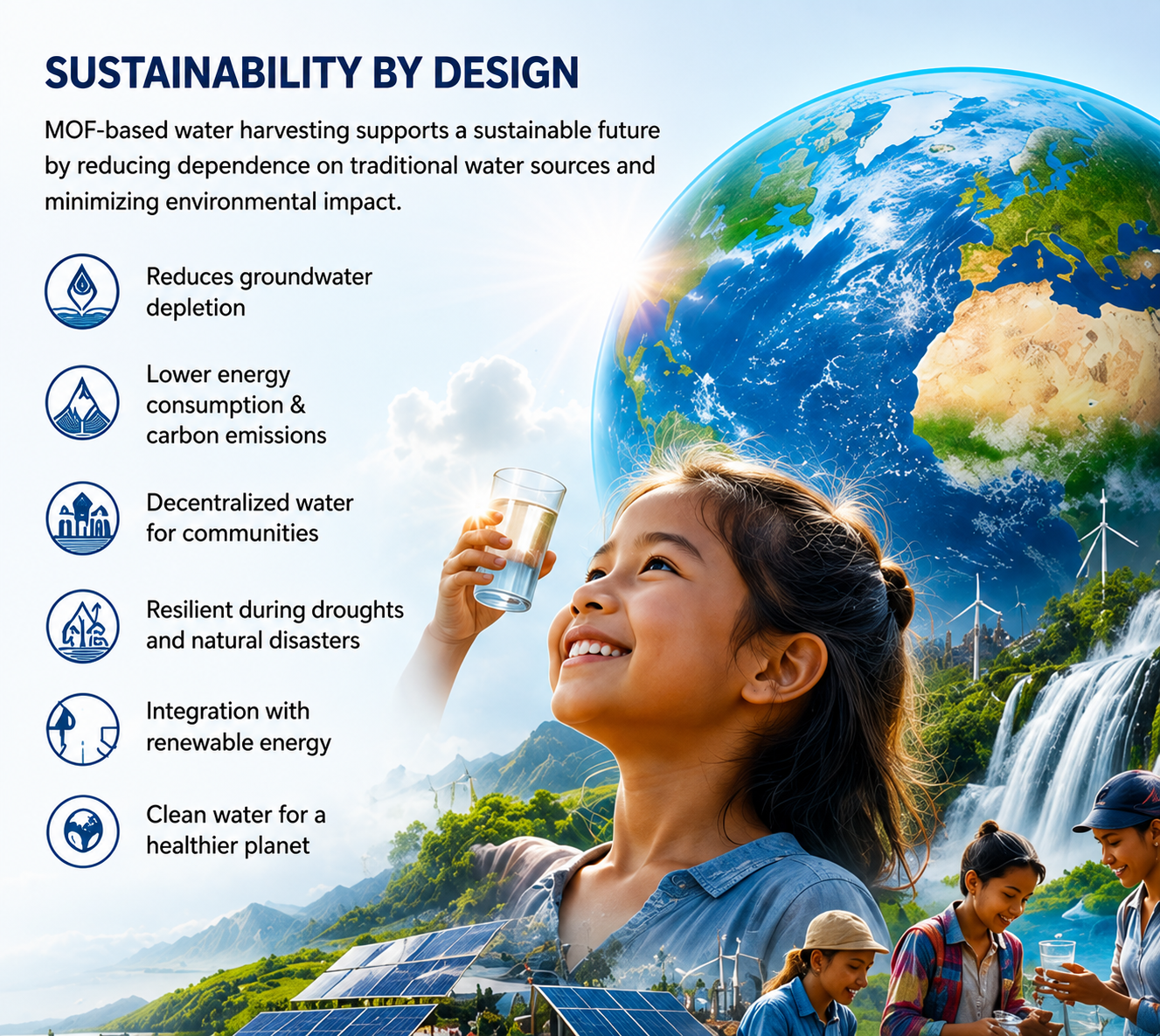
Sustainability by Design
Producing water should not require sacrificing the planet.
MOF-based atmospheric water harvesting supports a new generation of sustainable infrastructure by reducing dependence on groundwater extraction, long-distance water transportation, and energy-intensive desalination.
Potential environmental benefits include: –
– Reduced groundwater depletion
– Lower carbon emissions compared with conventional water production methods (system-dependent)
– Decentralized water generation for remote communities
– Increased resilience during droughts and natural disasters
– Integration with renewable energy systems
– Reduced dependence on single-source water infrastructure
Clean water becomes available where people need it most—not only where pipelines exist.
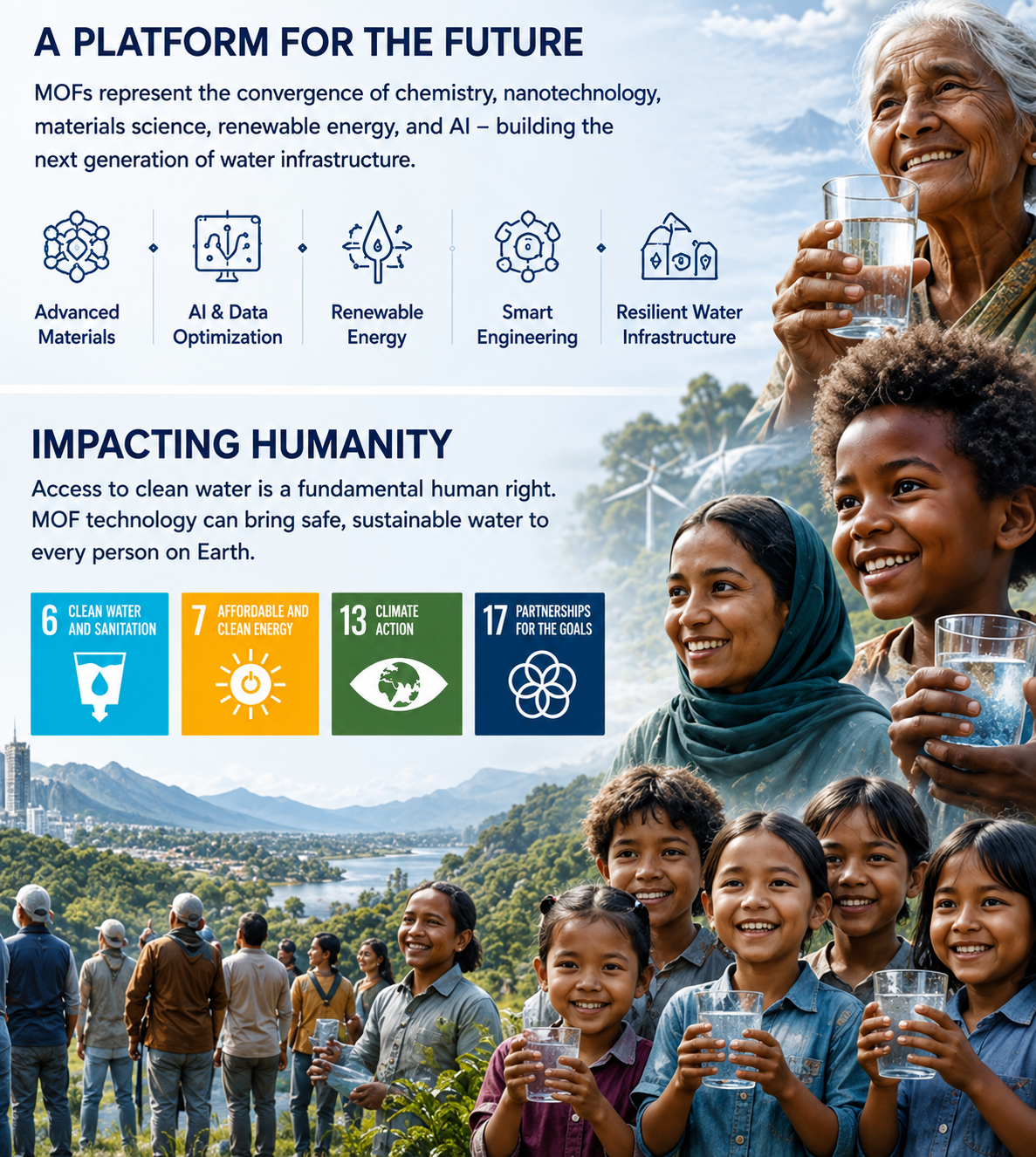
A Platform for the Future
MOFs represent far more than an incremental improvement in atmospheric water generation.
They establish an entirely new scientific platform where advanced chemistry, nanotechnology, materials engineering, renewable energy, and artificial intelligence converge.
As new generations of MOFs continue to improve adsorption efficiency, durability, manufacturability, and regeneration performance, atmospheric water harvesting is expected to become an increasingly important component of resilient water infrastructure.
The future of water will not depend solely on discovering new water sources.It will depend on engineering smarter materials capable of harvesting the water already surrounding us.