
Harvest Water from The Air

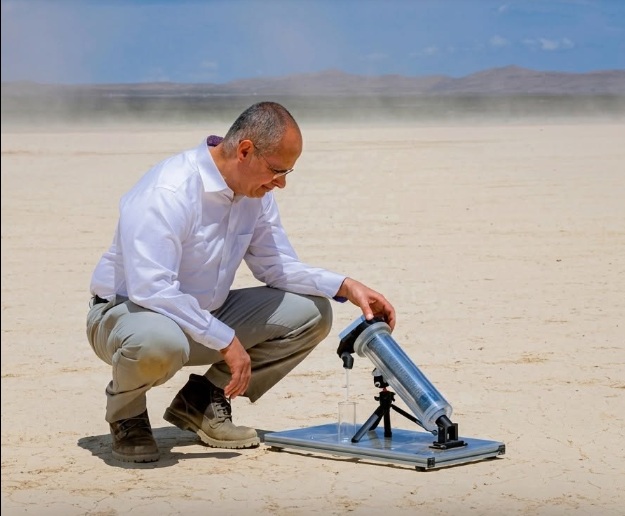
Where Inspiration Begins………….Thank you to Nobel Laureate, Professor Omar Yaghi.
One of the top inventors and one of the most cited chemists in the world today. Professor Yaghi is the founder of the reticular chemistry field of science; among his top inventions are the Metal-Organic Frameworks (MOFs), Zeolitic Imidazolate Frameworks (ZIFs), Covalent Organic Frameworks (COFs) and the molecular weaving technologies. Professor Yaghi has received more than 55 prestigious global awards and medals throughout his celebrated career.
“Harvesting Water from the Desert”
The Breakthrough MOF Technology by Nobel Laureate
MOF-303: Solar-Powered Water Harvesting Technology for a Water-Scarce World
As access to clean water becomes increasingly uncertain, scientists are exploring a fundamental question: could the moisture in the atmosphere become a reliable new source of water for humanity?One promising answer lies in atmospheric water harvesting technology powered by Metal-Organic Frameworks, or MOFs. These advanced porous materials were pioneered by Professor Omar M. Yaghi of the University of California, Berkeley, a leading figure in the field of reticular chemistry.By capturing water molecules directly from the air and releasing them using solar heat, MOF-based systems could enable communities to produce water even in extremely dry regions with limited access to conventional water infrastructure.
The Global Water Crisis Is Closer Than We Think
Global water scarcity is no longer a distant concern. International organizations have warned that more than five billion people could face inadequate access to water for at least part of the year by 2050.This challenge is not limited to desert nations. Climate change, prolonged droughts, population growth, urban expansion, agricultural demand and pressure on aging water infrastructure are increasing water insecurity around the world.Atmospheric water harvesting is therefore emerging as a complementary solution for locations where surface water, groundwater and centralized distribution systems are unavailable, unreliable or environmentally unsustainable.
What Is MOF-303?
MOF-303 is an aluminium-based Metal-Organic Framework composed of metal nodes connected by organic molecules. Together, these components form a highly ordered network containing an enormous number of molecular-scale pores.Its internal structure provides a remarkably large surface area and can be engineered to interact selectively with water molecules. This allows MOF-303 to capture moisture efficiently, even when very little water is present in the surrounding air.Rather than cooling large volumes of air below their dew point—as conventional condensation-based atmospheric water generators typically do—the MOF first concentrates water molecules inside its pores. Solar heat can then release the captured water as vapour for subsequent condensation and collection.
How a Passive MOF Water Harvester Works
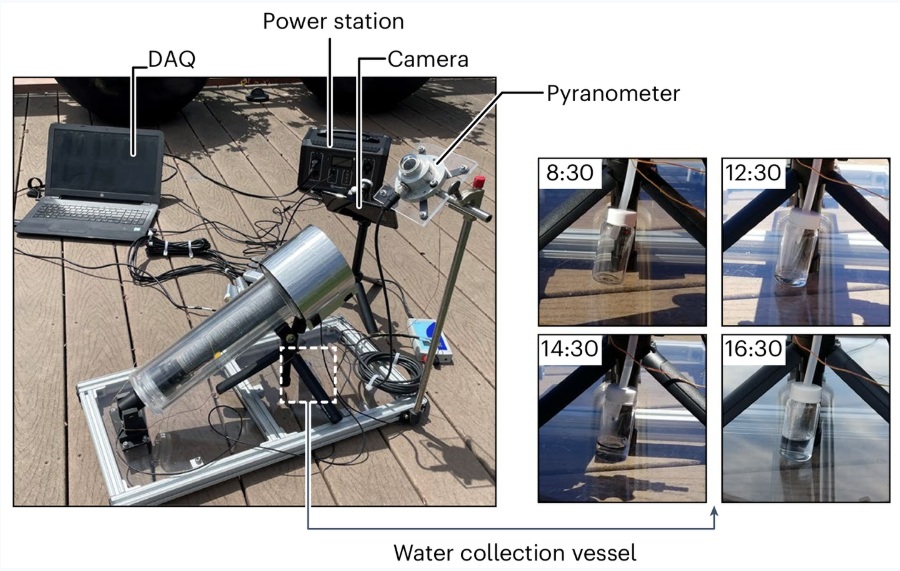
The water-harvesting cycle consists of two principal stages.
At Night: Capturing Water from the Atmosphere
When air passes through a cartridge containing MOF-303, water molecules enter its microscopic pores and attach to the internal surface of the material.
The MOF can continue capturing moisture under extremely dry conditions where conventional atmospheric water generation may require substantial energy to cool and condense the air.
During the Day: Releasing Water with Solar Heat
As sunlight warms the material, the captured molecules are released as water vapour.
The vapour is then directed toward a cooler condensation surface, where it forms liquid droplets and flows into a collection chamber.The prototype is designed to use natural sunlight and passive thermal management.
It does not require an external electricity supply or battery to drive the fundamental adsorption–desorption cycle.This makes the concept particularly relevant to off-grid communities, emergency environments and remote areas where both water and electricity are limited.
Tested Under the Extreme Conditions of Death Valley
Researchers tested a MOF-303 water-harvesting prototype in Death Valley National Park, California—one of the hottest and driest environments on Earth.During field testing, the system operated under temperatures ranging from approximately 21.9°C to 60.7°C and relative humidity levels between 9.4% and 36%.Despite these severe conditions, the prototype continued to harvest water from the atmosphere. Its maximum reported water productivity in Death Valley was approximately 210 grams of water per kilogram of MOF-303 per day.During testing in Berkeley, where the environmental conditions were more favourable for condensation, the system reached approximately 285 grams of water per kilogram of MOF-303 per day.
These results are significant because extracting water from very dry air through conventional cooling can be energy intensive. MOF-303 takes a different approach by selectively capturing water molecules before releasing them in a more concentrated form.
More Than a Breakthrough Material
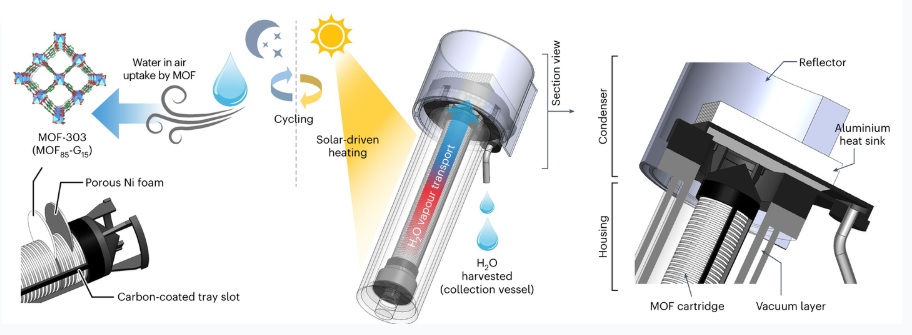
MOF-303 is the molecular engine of the system, but the performance of a practical water harvester depends on much more than chemistry alone.Important engineering considerations include:-
– Maximising contact between atmospheric air and the MOF
– Distributing solar heat evenly across the adsorbent material
– Reducing heat loss through advanced insulation
– Managing the temperature difference between desorption and condensation zonesImproving droplet formation and water drainage
– Protecting the system from dust and environmental contamination
– Designing the device for durability, maintenance and repeated operating cycles
The research combines materials science with thermal modelling, mass-transfer analysis and device engineering. Across the broader field, computational chemistry, machine learning and data science are also being used to accelerate the discovery and evaluation of new porous materials.
These digital approaches can help researchers screen potential structures, predict adsorption behaviour and identify promising materials before conducting extensive laboratory experiments.
However, experimental validation remains essential before any material or device can be considered ready for real-world deployment.
From Laboratory Prototype to Future Water Infrastructure
MOF-based atmospheric water harvesting remains an evolving technology.
Further development is required to increase water output, reduce material and manufacturing costs, validate long-term performance and assess environmental impacts across the complete product life cycle.
Its potential applications, however, extend far beyond a small laboratory device.
Future systems could support:-
– Residential water generation in dry climates
– Community-scale water systems in remote areas
– Emergency and disaster-response operations
– Off-grid water supply for islands and desert locations
– Agricultural and controlled-environment applications
– Hotels, hospitals and industrial facilities
– Decentralised water infrastructure
– Integration with solar energy and waste-heat recover
MOF water harvesting should not be presented as a single replacement for all existing water systems. Its greatest value may come from serving as part of a diversified water strategy alongside conservation, recycling, desalination, rainwater collection and responsible groundwater management.
Water Quality Must Be Engineered into the Complete System
Capturing water molecules from the atmosphere is only the first stage of producing safe drinking water.Any commercial drinking-water system must also address air filtration, material safety, microbial control, condensation-surface hygiene, post-treatment, mineralisation, storage and regular quality monitoring.The complete device—not only the MOF material—must comply with the relevant drinking-water, electrical, sanitation and consumer-product standards in each market.For this reason, water collected by a research prototype should not automatically be described as ready for direct consumption unless the complete treatment system has been tested and certified accordingly.
Could the Atmosphere Become a New Water Source?
Water vapour is continuously transported and replenished through the global hydrological cycle.
Atmospheric water harvesting introduces a decentralised model in which water can potentially be produced close to the point of use, reducing dependence on pipelines, groundwater extraction and long-distance transportation.MOF-303 demonstrates that water molecules can be captured even in environments with extremely low humidity and very high temperatures.
This technology alone will not resolve the global water crisis.
Nevertheless, it could become an important part of a future water ecosystem in which different technologies are selected according to local climate, infrastructure, energy availability and community needs.
The larger vision is not simply to build a machine that extracts water from air. It is to create resilient, decentralised and environmentally responsible access to one of humanity’s most essential resources.
Research and Commercial Collaboration
We welcome opportunities to exchange knowledge and explore collaboration in:-
– Metal-Organic Frameworks and advanced porous materials
– Atmospheric water harvesting
– Passive and solar-powered water systems
– Thermal management and condensation technology
– Renewable energy integration
– Decentralised water infrastructure
– Prototype development and field testing
– Manufacturing and commercial-scale deployment
We are open to discussions with universities, researchers, technology owners, engineers, manufacturers, investors, public-sector organisations and industrial partners interested in translating scientific knowledge into practical solutions.
Whether the opportunity begins with academic exchange, material development, a pilot installation, joint research or commercial deployment, we believe meaningful progress begins with open and constructive dialogue.
If you are developing a technology or research programme that could improve access to clean water, reduce energy consumption or create measurable benefits for society, we would be pleased to hear from you.
From molecular innovation to real-world water resilience.
Contact us to discuss research collaboration, technology development, pilot projects, investment opportunities or commercial partnerships.
hello@gluon.energy